What Is Gear Module? A Practical Guide for Engineers
What Is Gear Module? A Practical Guide for Engineers
When selecting a metric gear, one of the first specifications you will encounter is module. You may see gears identified as Module 1, Module 1.5, Module 2, Module 2.5, Module 3, Module 4, Module 5, and so on.
But what does gear module actually mean, and why is it so important?
For engineers, maintenance teams, and equipment designers, understanding module makes it much easier to identify compatible gears, calculate dimensions, determine center distances, and select the right components for a power transmission application.
This guide explains gear module in practical terms and covers the calculations you need to know when specifying metric gears.
What Is Gear Module?
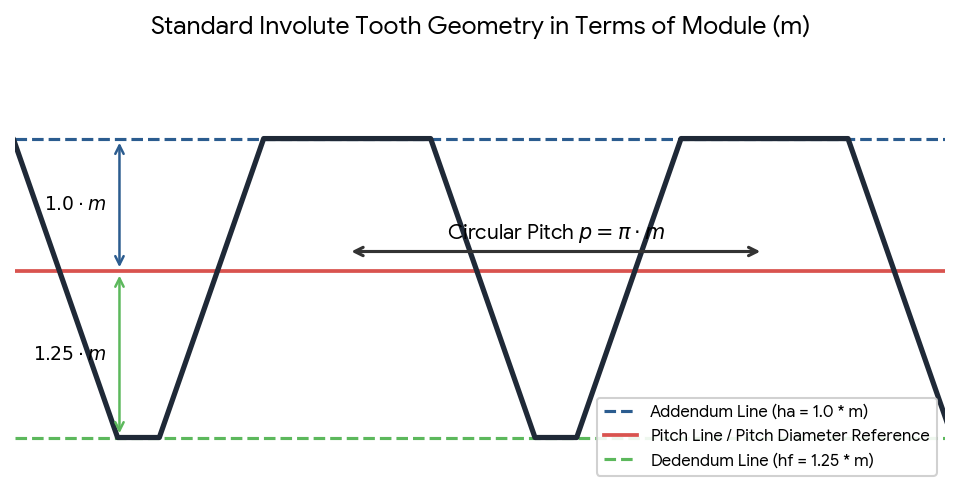
Gear module is a metric measurement that describes the size of a gear's teeth.
The module is calculated by dividing the gear's pitch diameter, in millimeters, by its number of teeth:
m = d ÷ z
Where:
- m = module
- d = pitch diameter in millimeters
- z = number of teeth
The module is a standardized way of defining tooth size. Two gears intended to mesh properly must have compatible tooth geometry, including the same module and pressure angle.
For example, suppose a gear has 20 teeth and a pitch diameter of 40 mm:
40 mm ÷ 20 teeth = Module 2
That gear would therefore be a Module 2 gear.
Gear module is particularly important when working with metric machinery because it provides a straightforward way to specify and match gears.
How Does Module Affect Gear Size?
As module increases, the gear teeth become larger.
A Module 1 gear has relatively small teeth, while a Module 5 or Module 8 gear has substantially larger teeth. Larger modules are generally associated with larger tooth dimensions and can be appropriate for applications requiring greater load capacity, although the actual load capacity of a gear depends on many factors beyond module alone.
This is important when designing machinery because increasing module can affect:
- Overall gear diameter
- Tooth size
- Center distance
- Available space
- Torque transmission
- Gear weight
- Speed capabilities
- Gearbox dimensions
For example, A2Z Metric Components offers metric spur gears in several modules, including Module 1.5, Module 2.5, Module 5, and Module 8.
Calculating Pitch Diameter From Module
Once you know the module and number of teeth, you can calculate the pitch diameter using a simple formula:
d = m × z
For example, consider a Module 2.5 gear with 20 teeth:
2.5 × 20 = 50 mm
The gear has a theoretical pitch diameter of 50 mm.
This relationship is useful when designing a gear train or trying to identify a replacement gear.
It also demonstrates why the number of teeth alone isn't enough to identify a metric gear. A 20-tooth gear could have a very different pitch diameter depending on its module.
A2Z Metric's Module 2.5 spur gear specifications, for example, list a 20-tooth gear with a 50 mm pitch diameter.
Module and Center Distance
Module is also important when determining the center distance between two mating spur gears.
For two standard external gears, the approximate center distance is:
C = (d₁ + d₂) ÷ 2
Because pitch diameter can be calculated from module and tooth count, this can also be written as:
C = m(z₁ + z₂) ÷ 2
For example, imagine two Module 2 gears:
- Gear 1 = 20 teeth
- Gear 2 = 40 teeth
Their pitch diameters would be:
Gear 1: 2 × 20 = 40 mm
Gear 2: 2 × 40 = 80 mm
The theoretical center distance would therefore be:
(40 + 80) ÷ 2 = 60 mm
This is one reason module needs to be established early in a gear design. It directly affects the geometry of the gear train.
Do Mating Gears Need the Same Module?
Yes. For standard metric spur gears to mesh correctly, they need compatible tooth geometry, including the same module.
For example:
Module 2 + Module 2 = compatible module
But:
Module 2 + Module 3 = not compatible
The pressure angle also needs to be considered. A2Z Metric Components' metric spur gears are specified with a 20° pressure angle, which is a common gear specification.
When replacing an existing gear, therefore, don't simply match the outside diameter. Module, tooth count, pressure angle, bore, face width, and other dimensions may all matter.
Module vs. Number of Teeth
Module and tooth count work together, but they describe different things.
Module describes the relative size of the teeth.
Number of teeth describes how many teeth are around the gear.
Together, they determine the gear's pitch diameter.
For example:
|
Module |
Teeth |
Pitch Diameter |
|
1.5 |
20 |
30 mm |
|
2 |
20 |
40 mm |
|
2.5 |
20 |
50 mm |
|
5 |
20 |
100 mm |
The same number of teeth can therefore produce dramatically different gear sizes when the module changes.
What Other Gear Dimensions Matter?
Module is important, but it is only one part of a complete gear specification.
When sourcing a replacement or designing a new gear, engineers may need to specify:
- Module
- Number of teeth
- Pressure angle
- Pitch diameter
- Outside diameter
- Bore diameter
- Hub diameter
- Face width
- Keyway requirements
- Material
- Heat treatment
- Gear type
- Rotation and application requirements
For example, A2Z Metric's metric spur gear specifications include the number of teeth, bore, hub diameter, outside diameter, and pitch diameter in addition to module.
This is why simply telling a supplier that you need a "20-tooth metric gear" may not be enough to identify the correct component.
How Do You Identify the Module of an Existing Gear?
If you're replacing an unknown gear, start by gathering as many measurements as possible.
Count the number of teeth and measure the gear's dimensions. If you can determine the pitch diameter accurately, the basic calculation is:
Module = pitch diameter ÷ number of teeth
However, determining the true pitch diameter from physical measurements isn't always straightforward. The standard pitch diameter is a reference dimension defined by the gear geometry rather than simply a dimension you can measure across the outside of the teeth.
If you're unsure, don't guess.
A gear supplier or engineer can often identify the appropriate gear from a combination of measurements, photographs, drawings, part numbers, and application information.
Why Correct Module Matters
Using the wrong module can prevent two gears from meshing correctly.
A mismatch can result in:
- Poor tooth engagement
- Excessive noise
- Accelerated wear
- Vibration
- Increased friction
- Reduced efficiency
- Tooth damage
- Premature gear failure
Even if two gears appear similar in size, their tooth geometry may be incompatible.
For replacement applications, matching the original module is therefore an important first step.
Common Metric Gear Modules
There is no single module that works for every application. Metric gears are available in a range of standardized sizes.
A2Z Metric Components supplies metric gear racks in modules including 1, 1.5, 2, 2.5, 3, 4, 5, 6, and 7, with additional larger and custom sizes available.
The appropriate module depends on the application, available space, loads, speed, gear dimensions, and other design requirements.
For that reason, selecting a gear shouldn't be based on module alone.
Need Help Sourcing the Right Metric Gear?
Finding the correct replacement gear can be difficult when you don't have a complete part number or drawing.
That's where A2Z Metric Components can help.
A2Z supplies precision metric gears and other mechanical components, including metric spur gears and gear racks. Standard options are available in multiple modules, materials, and configurations, while custom gears and modifications are also available.
If you have an existing gear that needs to be replaced, send A2Z your drawing, dimensions, part number, photos, or application requirements. Their team can help identify the appropriate component or develop a sourcing solution.
Call A2Z Metric Components at 1-833-METRIC2 (1-833-638-7422) or email [email protected] to source the right gear for your application.
Frequently Asked Questions About Gear Module
What does module mean on a gear?
Module is a metric measurement used to define the size of a gear's teeth. It is calculated as pitch diameter divided by the number of teeth.
How do I calculate gear module?
Use the formula:
Module = pitch diameter ÷ number of teeth
The pitch diameter should be expressed in millimeters.
Do two gears need the same module?
Standard mating metric gears need the same module and compatible tooth geometry. Pressure angle and other specifications must also be compatible.
Does a larger module mean a stronger gear?
Not necessarily by itself. A larger module means larger teeth, but gear strength also depends on material, face width, tooth geometry, heat treatment, speed, lubrication, loading, and other design factors.
How do I find the module of an unknown gear?
Count the teeth and determine the pitch diameter if possible, then divide pitch diameter by tooth count. Because pitch diameter can be difficult to determine from physical measurements, it's often best to provide the supplier with as many dimensions and details as possible.
What information should I provide when ordering a replacement gear?
Provide the module, tooth count, bore, outside diameter, face width, pressure angle, material, hub dimensions, keyway information, and any available part number or drawing. Photos and application information can also be useful.
Can A2Z Metric Components source custom gears?
Yes. A2Z Metric Components offers standard metric gears as well as custom and modified components. If you can't find the exact gear you need, contact A2Z with your dimensions, drawing, part number, or application requirements.
Get the Right Metric Gear for Your Application
Gear module is one of the most important specifications to understand when selecting metric gears. It establishes tooth size and, together with tooth count, determines the pitch diameter and helps establish the geometry of the gear train.
But selecting the correct gear involves more than module alone.
If you're replacing a worn gear, designing new equipment, or trying to identify an obsolete metric component, contact A2Z Metric Components before ordering. Call 1-833-METRIC2 (1-833-638-7422) or email [email protected] with your gear dimensions, drawing, part number, photos, or application details.
A2Z Metric Components can help you source the right gear for your application.